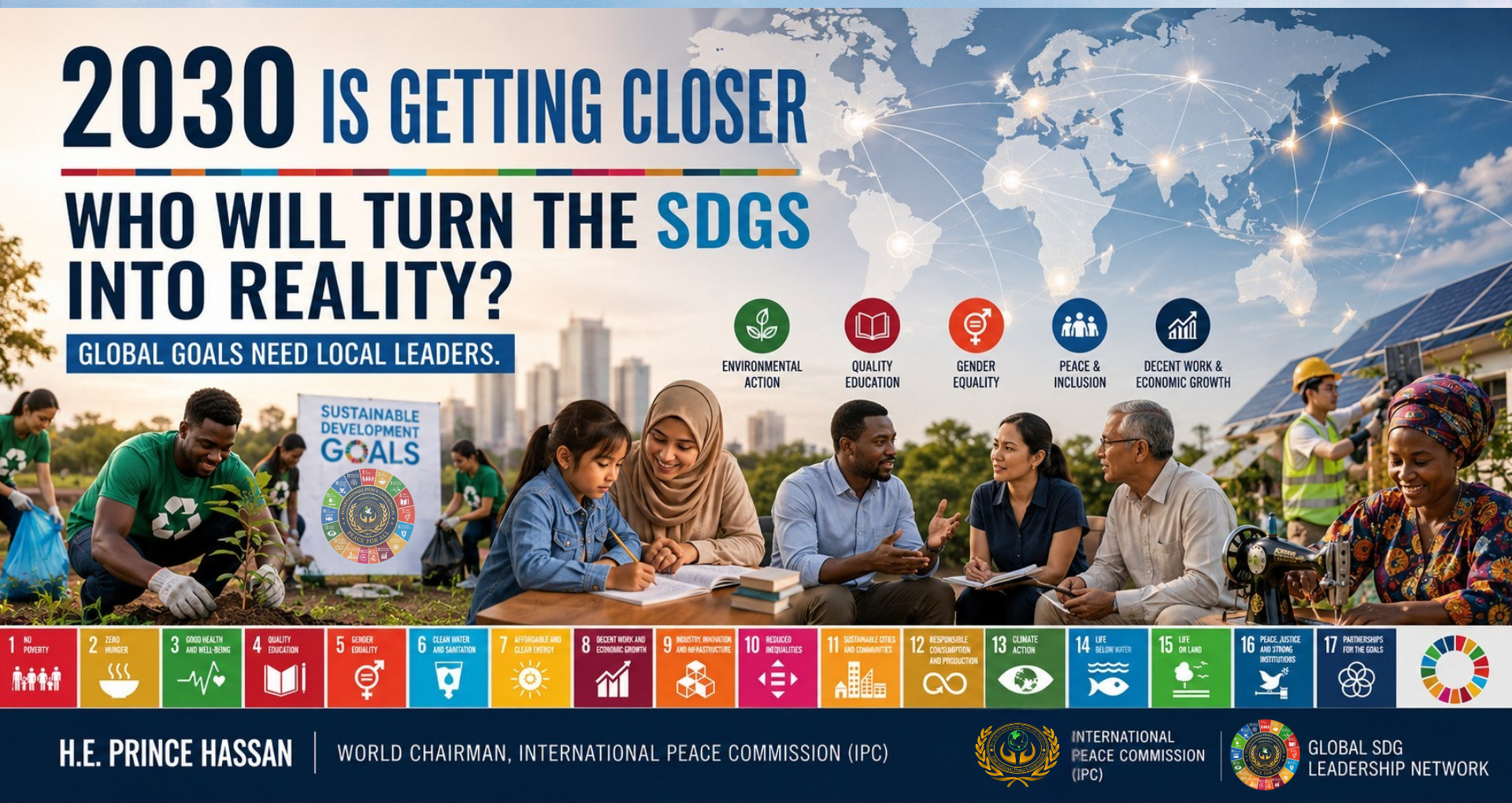
In 2015, the international community adopted one of the most ambitious development frameworks in modern history: the 2030 Agenda for Sustainable Development and its 17 Sustainable Development Goals.
The vision was extraordinary in scope: ending poverty and hunger, improving health and education, advancing gender equality, expanding access to clean water and sustainable energy, creating decent work, building sustainable communities, protecting the planet, strengthening institutions, promoting peace, and developing partnerships capable of carrying this work forward.
More than a decade later, 2030 is no longer a distant destination.
The world has spent years explaining the Sustainable Development Goals, building awareness around them, and integrating them into national strategies, institutional programs, corporate commitments, academic research, and civil-society work.
The challenge before us now is increasingly one of implementation.
The defining question of the remaining years is simple:
Who will turn the SDGs into reality?
Progress Is Possible, but It Is Not Happening Fast Enough
The global picture is mixed.
There has been meaningful progress across several areas of sustainable development. Access to electricity, drinking water, sanitation, digital connectivity, healthcare, education, and social protection has expanded for millions of people. Innovation, technology, local entrepreneurship, and cross-sector partnerships continue to create new opportunities.
Governments, international organizations, businesses, universities, civil-society organizations, and communities have all demonstrated that coordinated action can improve lives.
At the same time, progress remains deeply uneven.
Poverty, hunger, conflict, inequality, climate pressures, displacement, debt burdens, and financing constraints continue to affect communities throughout the world. Many SDG targets are advancing too slowly, while others have stalled or moved backward. The people already facing the greatest barriers are often the people most at risk of being left behind.
This does not mean that the Sustainable Development Goals have failed.
It means that the remaining period requires a much stronger transition from commitment to implementation.
The world already possesses considerable knowledge about what needs to be done. The greater challenge is mobilizing the leadership, financing, institutions, partnerships, technology, trust, and local capacity necessary to do it at sufficient scale.
Global Goals Are Ultimately Experienced Locally
Sustainable development is often discussed at the level of nations and international institutions. We speak about global agreements, national policies, development financing, multilateral cooperation, corporate sustainability commitments, and international indicators.
All of these are essential.
But the actual experience of development is profoundly local.
Poverty is experienced within households. Hunger affects individuals and families. A lack of education affects the child who cannot access safe, meaningful learning. Gender inequality restricts the real opportunities, safety, and participation of women and girls. Unsafe water affects the community that depends upon it. Climate change reaches people through drought, flooding, food insecurity, crop failure, extreme weather, disease, and displacement.
Weak institutions are experienced through corruption, exclusion, insecurity, injustice, and the loss of public trust.
Peace is also experienced locally—in communities where people either live with security, dignity, inclusion, opportunity, and hope, or face fear, discrimination, exclusion, division, and violence.
The SDGs may be global goals, but their success or failure will ultimately be experienced locally.
That reality should influence how we approach the years ahead.
International commitments must eventually reach cities, towns, villages, schools, workplaces, homes, and neighborhoods. Policies must become programs. Resources must reach people. Partnerships must produce results.
And somewhere in that process, someone must lead.
Governments Cannot Do It Alone
Governments carry enormous responsibility for sustainable development. They establish laws, determine national priorities, build infrastructure, finance public services, protect rights, and create the policy environment within which development can succeed.
International organizations contribute technical expertise, coordination, standards, advocacy, and resources. Businesses provide investment, innovation, employment, technology, and supply-chain influence. Universities and researchers generate knowledge, evidence, and solutions. Civil-society organizations provide advocacy, specialized expertise, accountability, and direct access to communities.
Each has an essential role.
But sustainable development has never been intended to belong exclusively to institutions.
Behind almost every successful community initiative, there are individuals willing to take responsibility. They identify problems, listen to communities, organize people, build trust, create partnerships, engage institutions, and turn ideas into practical activities.
Policies create possibilities.
Institutions create structures.
Financing creates capacity.
People create movement.
This human dimension of sustainable development deserves far greater attention.
The World Also Needs More Practical Leaders
Much of the global development conversation understandably focuses on financing, institutional capacity, technology, and policy.
But there is another resource without which none of these can reach their full potential: leadership.
Leadership in this context does not mean political office, organizational rank, wealth, or prestigious titles. It means the ability and willingness to recognize a problem, accept responsibility, bring people together, and create constructive action.
That leadership can come from a teacher organizing an educational initiative, a young professional mentoring others, a community organizer addressing sanitation, a health professional providing public education, an entrepreneur creating opportunities, a journalist bringing attention to an overlooked issue, or a peace advocate creating dialogue in a divided community.
It can come from students, researchers, artists, volunteers, retired professionals, parents, disability-rights advocates, faith leaders, local business owners, farmers, and ordinary citizens who decide that their knowledge, relationships, or experience can contribute to something larger than themselves.
No single individual will achieve the Sustainable Development Goals.
But the Goals will not be achieved without millions of individuals choosing to contribute.
Awareness Must Now Produce Action
Over the past decade, awareness of the Sustainable Development Goals has expanded significantly.
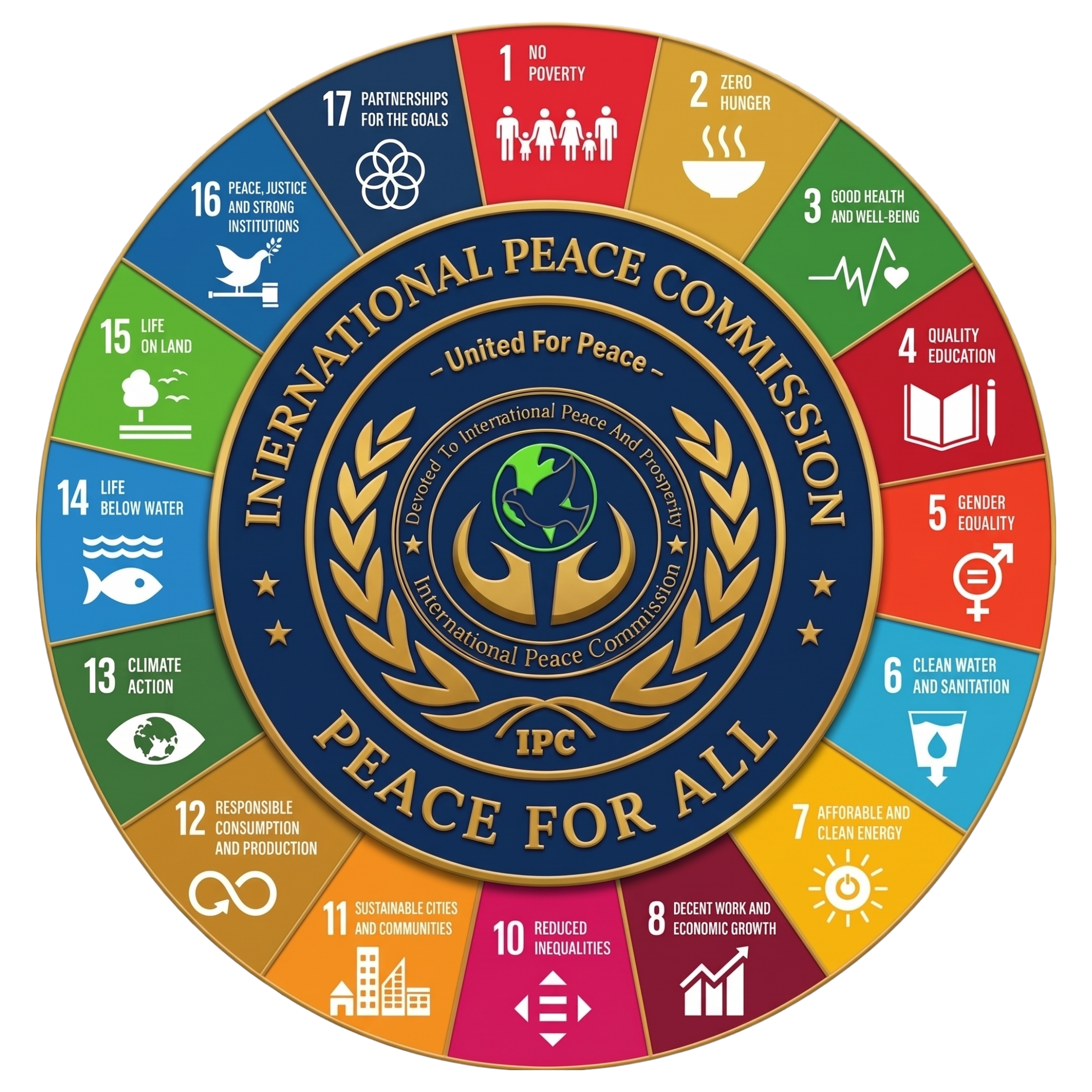
The SDG wheel appears at conferences, universities, businesses, government events, academic programs, community initiatives, and across social media. Organizations publish commitments. Institutions align programs with particular Goals. Millions of people have become familiar with the language of sustainable development.
This awareness has value.
But awareness was never intended to be the destination.
The purpose of understanding the Goals is ultimately to help advance them.
Understanding SDG 6—Clean Water and Sanitation—should lead us toward addressing water, hygiene, and sanitation challenges. Commitment to SDG 4—Quality Education—should encourage action around access to learning, teacher support, digital inclusion, and lifelong opportunity. Support for SDG 5—Gender Equality—should translate into removing barriers facing women and girls. Concern for SDG 13—Climate Action—should produce responsible environmental action, adaptation, resilience, and climate awareness.
Commitment to SDG 16—Peace, Justice and Strong Institutions—should deepen our understanding that peace, justice, and strong institutions depend upon human rights, inclusion, accountability, dialogue, public trust, and the peaceful resolution of conflict.
The transition required now is clear:
From awareness to ownership.
From ownership to responsibility.
From responsibility to action.
That is where sustainable development becomes more than an international agenda. It becomes a shared culture of responsibility.
Leadership Does Not Always Begin With a Large Project
There is a tendency to associate development action with large budgets, major conferences, complex programs, and high-level institutions.
Many serious development challenges require substantial resources. Infrastructure, healthcare, education, climate adaptation, social protection, humanitarian response, and peacebuilding cannot be sustained without adequate financing.
Financing remains indispensable.
But leadership does not always have to begin with funding.
It may begin with twenty young people in a classroom, volunteers improving a neglected community area, a discussion about peace, an environmental-awareness activity, a mentoring program, a digital-literacy session, a women’s empowerment initiative, or an effort to connect vulnerable people with services already available to them.
It may begin by bringing together organizations that have been working separately on the same problem.
These actions should never be exaggerated into claims of transforming entire communities or achieving an SDG. Credibility requires honest measurement of what an activity actually accomplishes.
At the same time, small actions should not be dismissed simply because they are small.
Small action becomes significant when it is credible, sustained, measured, improved, and replicated.
A leader who consistently demonstrates responsible action becomes better positioned to build trust, attract volunteers, approach institutions, develop partnerships, and eventually mobilize larger resources.
Funding can expand leadership.
But leadership should not always have to wait for funding.
From Commitment to Contribution
A meaningful contribution does not have to begin globally to matter globally.
It begins by identifying a real challenge, listening to the people affected, developing partnerships, using available resources responsibly, taking practical action, and learning from the results.
A strong local-action process can be remarkably simple: identify the problem, understand which SDGs are connected to it, listen to the community, find appropriate partners, begin with realistic resources, measure what changes, improve the approach, and share what others can learn or replicate.
This does not replace national policy, international cooperation, or major development financing.
It helps translate those efforts into meaningful community-level action.
It also helps prevent a common mistake: confusing activity with impact.
A meeting is not automatically progress. A certificate is not automatically leadership. A social-media post is not automatically implementation.
Responsible action requires evidence, reflection, accountability, and a willingness to improve.
The Missing Link Is Often Connection
Across the world, capable people are addressing similar challenges without knowing one another.
An educator in Africa may be developing an approach relevant to someone working in Asia. A youth leader in Nigeria may be confronting the same challenge as a community organizer elsewhere. A researcher may possess knowledge that could strengthen a local initiative thousands of miles away.
A peacebuilder may need an environmental organization. A women’s empowerment advocate may benefit from working with entrepreneurs. A community organization may need a university partner. A promising idea may simply need the right connection.
This is one reason SDG 17—Partnerships for the Goals—is so important.
Sustainable development cannot operate effectively through isolated institutions, disconnected sectors, or individuals working alone.
The future must involve stronger connections not only between governments and organizations, but also between leaders, professions, communities, and countries. It must include stronger cooperation between universities and practitioners, businesses and communities, experienced professionals and young leaders, local organizations and international partners.
Networks can play an important role in making those connections possible.
When they are ethical, credible, accountable, and action-oriented, networks can help people find partners, share knowledge, strengthen capacity, avoid duplication, support innovation, document lessons, and make local work visible to a wider community.
Global Goals Need Local Leaders
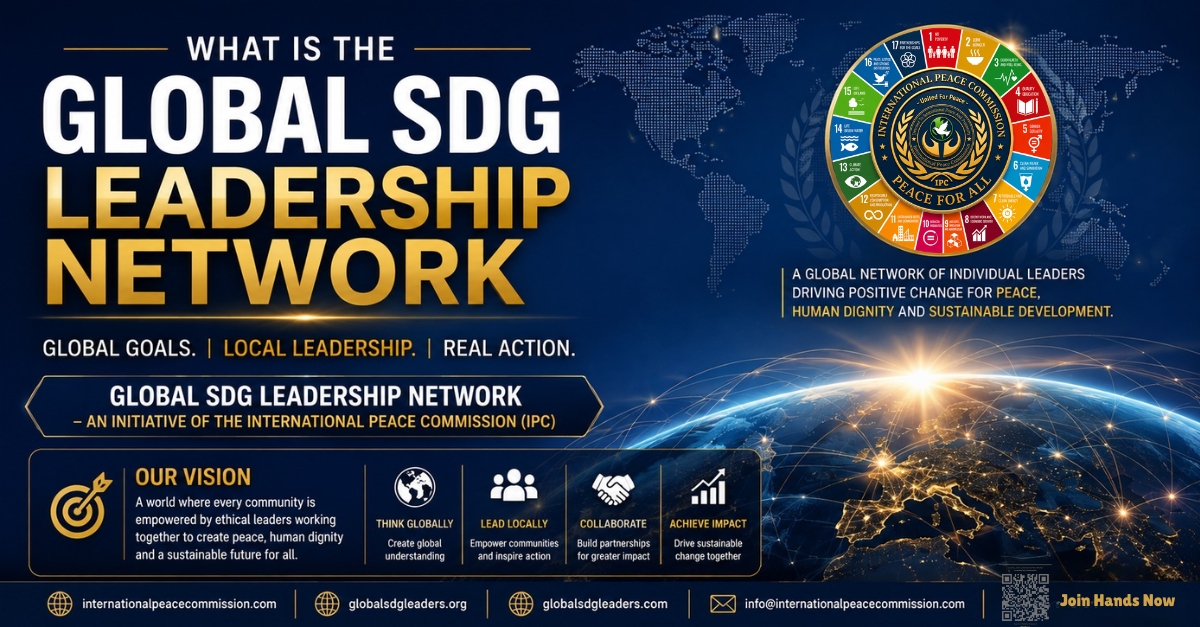
This understanding is part of the thinking behind the Global SDG Leadership Network—an initiative of the International Peace Commission.
The principle is straightforward:
Global goals need local leaders, and local leaders become stronger when they are connected globally.
The Network is not intended to create another collection of honorary titles, nor does it represent or appoint leaders on behalf of the United Nations.
Its purpose is to identify, connect, develop, support, and recognize individuals prepared to advance peace and sustainable development through responsible leadership, practical action, collaboration, and community engagement.
The model is based on multiplication.
A committed individual develops leadership capacity.
A leader builds a team.
A team engages a community.
Communities develop partnerships.
Partnerships expand opportunity.
Local initiatives connect across borders.
Shared learning strengthens future action.
Over time, isolated actions can become part of a much larger movement.
No leadership network can solve the world’s development challenges. But networks can help ensure that people willing to address those challenges are connected, supported, accountable, and visible.
Recognition Must Follow Contribution
Recognition is valuable.
Many people perform extraordinary community work without ever receiving appropriate visibility or acknowledgment. Responsible recognition can strengthen confidence, open doors to partnerships, encourage service, and help leaders gain the credibility required to expand their work.
But recognition should follow contribution rather than substitute for it.
An appointment, certificate, or title can identify a responsibility.
It cannot demonstrate impact.
Action gives leadership its meaning.
For this reason, credible leadership should increasingly be measured by participation, service, partnerships, ethical conduct, consistency, and documented results.
The most meaningful evidence of leadership is not the length of a person’s title. It is what happened because that person accepted responsibility.
Credible leadership can be seen in whether a person organizes people, builds trust, develops useful partnerships, reaches those at risk of being left behind, documents outcomes honestly, learns from challenges, and helps others succeed.
Activities should be documented. Outcomes should be examined. Lessons should be shared. Successful approaches should be replicated, and unsuccessful approaches should become opportunities to learn and improve.
This is how recognition gains credibility.
Peace Must Be Part of the Development Equation
For the International Peace Commission, there is another dimension to this discussion that cannot be overlooked.
Peace and sustainable development are inseparable.
A child living through conflict cannot easily benefit from the promise of quality education. Communities displaced by violence struggle to build sustainable prosperity. Families affected by insecurity struggle to maintain livelihoods, access healthcare, continue education, and plan for the future.
Extreme inequality can contribute to resentment and instability. Weak institutions undermine justice and public trust. Climate pressures can intensify competition over land, water, food, and other resources. Exclusion and discrimination can weaken social cohesion. A lack of dialogue can allow division and fear to grow.
Peace therefore cannot be treated only as something negotiated after violence begins.
It must also be built into development itself.
Education can strengthen peace. Economic opportunity can strengthen peace. Gender equality can strengthen peace. Human dignity can strengthen peace. Environmental responsibility can strengthen peace. Accountable institutions can strengthen peace. Dialogue, inclusion, and community participation can strengthen peace.
Likewise, peaceful, just, and inclusive societies create stronger foundations for sustainable development across every Goal.
This relationship between peace and development should become even more central as the international community considers both the remaining years of Agenda 2030 and what comes afterward.
The Remaining Years Must Belong to Implementation
The global situation is serious, but it is not hopeless.
Progress has already demonstrated that coordinated development efforts can change lives. The challenge is that progress is not occurring everywhere, for everyone, or quickly enough.
The remaining years therefore require greater urgency, stronger partnerships, better financing, responsible use of technology, local capacity-building, stronger institutions, inclusive participation, and a renewed commitment to peace and international cooperation.
But every global strategy eventually reaches the same point:
Implementation must happen somewhere.
Policies must be translated into action. Partnerships must be built. Communities must be engaged. Resources must reach people. Those at risk of being left behind must be reached. Activities must be measured honestly. Leaders must be prepared to serve.
The final years approaching 2030 should not be remembered merely for another series of conferences discussing what remains unfinished.
They should become years of accelerated implementation.
2030 Is a Deadline. Responsibility Is Not.
Even if every Sustainable Development Goal were achieved by 2030, humanity’s responsibility would not suddenly end.
There would still be children to educate, communities to strengthen, peace to protect, human rights to defend, institutions to improve, environmental damage to prevent, inequality to confront, and future generations whose interests must be protected.
The year 2030 provides a shared destination and necessary urgency.
But sustainable development is not a campaign with an expiration date.
It is a continuing responsibility.
That makes what we build during these remaining years especially important.
Our objective should not only be to reach targets. It should also be to develop the people, institutions, partnerships, and cultures of leadership capable of sustaining progress long after the deadline has passed.
The Question Now Belongs to All of Us
Governments, the United Nations, international organizations, businesses, donors, universities, and civil society all carry important responsibilities for the future of sustainable development.
But implementation cannot remain the responsibility of institutions alone.
Individuals also have a role.
For some, that contribution may involve financing or creating a major initiative. For others, it may mean teaching, organizing, mentoring, advocating, volunteering, researching, innovating, building partnerships, or connecting people who should be working together.
A contribution does not have to begin globally to matter globally.
The more useful question is:
What can I do, where I am, with what I have, for the people I can reach?
The SDGs need governments.
They need strong institutions, investment, businesses, science, technology, civil society, international cooperation, and partnerships.
But they also need something that cannot be created by a resolution or purchased through a development fund:
People willing to take responsibility.
2030 is getting closer.
The world has already defined the Goals.
Now we need the leadership to turn them into reality.
#SustainableDevelopment #SDGs #Agenda2030 #GlobalGoals #Leadership #Peace #Peacebuilding #LocalAction #CivilSociety #PartnershipsForTheGoals #InternationalPeaceCommission